
The green drink economy: how we built a billion-dollar business out of vegetables
How convenience, ritual, subscriptions, branding, and status created a multibillion-dollar market around something as simple as drinking plants.
Here is a fun business experiment.
Take some spinach. Add half a banana. Throw in some berries, seeds, and water. Blend.
You now have perhaps a few dollars’ worth of groceries.
Put it in a clear cup. Add a fashionable logo. Call it the Cellular Radiance Green Drink. Charge $18.
Somebody will buy it.
This sounds like I’m making fun of the green-drink business. I’m not. I think it’s fascinating.
Because somewhere between the farmer growing spinach and the customer carrying a beautifully branded smoothie through Los Angeles, enormous economic value has been created.
The question is: What exactly are we paying for?
First, this is a real market
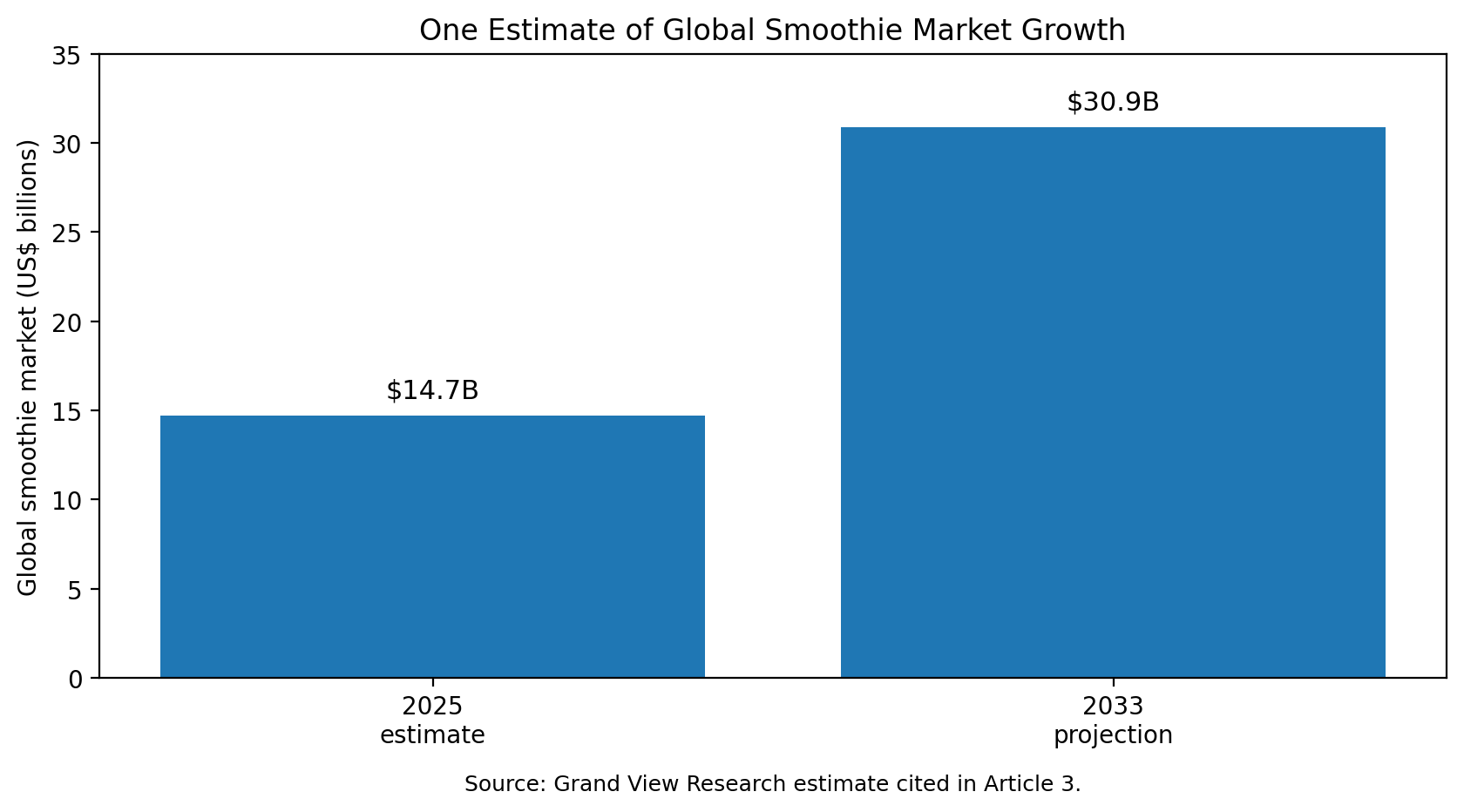
Figure 4. Grand View Research’s cited estimate places the global smoothie market at about $14.7B in 2025, with a $30.9B projection for 2033.
Smoothies are no longer a niche category.
Grand View Research estimates the global smoothie market at approximately $14.7 billion in 2025, rising to a projected $30.9 billion by 2033. North America represented approximately 44% of the market in 2025.
That’s not “health nuts drinking weird things.” That’s an industry.
Cold-pressed juice is a smaller but still substantial category. Grand View Research estimated the global cold-pressed juice market at about $790 million in 2023, with a forecast of approximately $1.26 billion by 2030. Interestingly, vegetable cold-pressed juices are projected to grow faster than the category overall.
And those figures don’t neatly capture the entire green-drink ecosystem. Add: greens powders; supplements; blenders; juicers; frozen smoothie packs; protein powders; functional ingredients; subscriptions; smoothie cafés; juice bars; supermarkets; delivery; celebrity collaborations; and wellness tourism.
There is an entire economy orbiting the simple desire to drink something healthy.
The green drink value chain
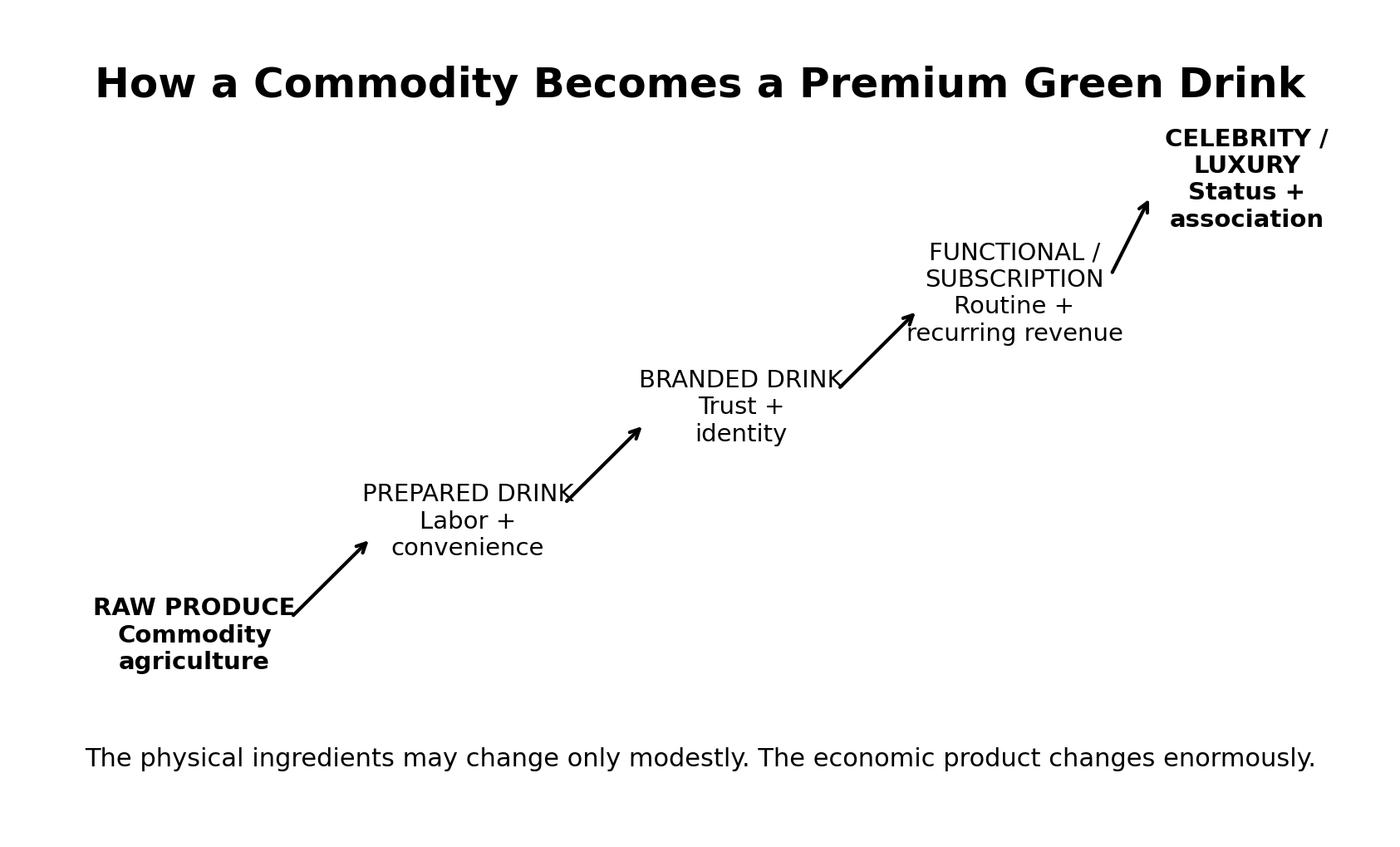
Figure 5. The economic value of a green drink rises as businesses add convenience, trust, ritual, identity, and status.
Let’s start with spinach. At the beginning of the chain, somebody grows it.
The economics look agricultural: land; seed; fertilizer; water; labour; harvesting; packing; transport.
The spinach is fundamentally a commodity.
Then something interesting happens. Each step away from “spinach” allows us to sell something more valuable.
Spinach becomes washed organic baby spinach becomes cold-pressed green juice becomes functional green drink becomes celebrity wellness smoothie becomes identity.
The physical plant hasn’t become twenty times more nutritious. But the economic product has changed completely.
What are you actually buying?
When someone pays $15 for a smoothie, they aren’t paying $15 for produce.
They’re buying: ingredients; preparation; labour; refrigeration; rent; equipment; waste; packaging; convenience; location; branding; trust; taste; and sometimes status.
That distinction matters.
People often look at restaurant food and say: “I could make that at home for $3.”
Correct. But you didn’t.
The business is selling the elimination of everything between wanting the thing and consuming the thing. No shopping. No washing. No chopping. No blender. No cleaning. No spoiled kale hiding behind the milk.
Hand over money. Receive health.
That’s valuable.
Smoothie economics can be very good
A smoothie business has several attractive characteristics.
The core production process is simple. A blender is not a commercial pizza oven. The product can be assembled quickly. Recipes can be standardized. Customization is easy. Drinks can carry relatively high perceived value. Add-ins can increase ticket size. And consumers may develop extremely repetitive habits.
Someone doesn’t usually eat at the same steakhouse five mornings a week. They might buy the same smoothie five mornings a week. That recurring behavior is enormously valuable.
Look at the scale of the established chains.
Smoothie King says it has more than 1,250 stores. Its franchise materials report average unit volume around $829,000 among the top 50% of units in the relevant disclosure data.
Tropical Smoothie Cafe generated an estimated $1.42 billion in U.S. system sales across 1,515 locations in 2024, according to Technomic data reported by Restaurant Business. Its average unit volume reportedly reached about $1 million in 2024, before dipping to about $964,000 in 2025 as it opened new stores quickly.
People really like drinking their food.
But fresh juice has an economic problem
Fresh plants die. That’s inconvenient.
Produce spoils. Juice deteriorates. Refrigeration costs money. Demand fluctuates.
Employees prepare too much and you throw inventory away. Prepare too little and you lose sales. Fresh-food businesses constantly fight waste.
That creates an obvious business opportunity. What if we remove the water?
Enter the green powder
Now we have a completely different economic animal.
Fresh green drink: heavy; perishable; refrigerated; locally prepared; short shelf life.
Green powder: light; shelf-stable; shippable; portionable; subscription-friendly; international.
From a business perspective, powder is beautiful.
You can manufacture a batch. Package it. Put it in a warehouse. Ship one tub. Then automatically ship another next month. And another. And another.
You have converted vegetables into recurring revenue.
The subscription changes everything
A juice bar waits for you to walk through the door. A subscription company already has your credit card. That’s a profound difference.
Suppose a green powder costs $80 per month. One customer staying for a year represents: $960 in annual revenue. Ten thousand customers: $9.6 million. One hundred thousand: $96 million.
Now you understand why the internet is full of people telling you about their morning greens.
The product isn’t merely nutritionally attractive. The business model is attractive.
The ritual is the moat
This may be the most important economic insight in the entire category.
Green drinks naturally attach themselves to routines. Wake up. Drink water. Make coffee. Drink greens. Exercise. Shower. Start work.
Once the product occupies a fixed place in someone’s morning, cancelling it isn’t simply cancelling a supplement. It disrupts a ritual. That is extraordinarily valuable to a consumer brand.
The best green-drink companies aren’t merely trying to convince you: “This product is healthy.”
They’re trying to reach: “My morning feels wrong without this.”
That’s an entirely different level of customer retention.
Then Hollywood discovered the unit economics of fame
And nobody illustrates the next stage better than Erewhon.
The Hailey Bieber Strawberry Glaze Skin Smoothie became an extraordinary phenomenon. Reports put sales around 40,000 smoothies per month during its most visible period. Fast Company reported that a single smoothie variant generated about $10.6 million.
One smoothie. Let that sink in. Not an entire smoothie chain. A smoothie recipe.
At 40,000 drinks per month, you’re looking at roughly: 480,000 smoothies per year.
At around $20 each, that’s approximately: $9.6 million in annualized retail sales before considering price changes or variations in monthly volume.
Suddenly the ridiculous $20 smoothie doesn’t look ridiculous from the other side of the cash register. It looks brilliant.
The customer became the advertisement
Here’s the beautiful part.
People photograph the smoothie. They post it. They discuss whether it’s worth $20. Other people mock them for buying it. News organizations write about the ridiculous smoothie. Influencers recreate it. YouTube creators calculate its calories. Tourists arrive wanting to try it.
Everyone is now marketing the smoothie. Including the people complaining about the smoothie.
That’s an extraordinary marketing machine.
Ingredient placement becomes advertising
Then Erewhon found another layer of economics. The ingredients themselves became advertising inventory.
Vogue Business reported that brands included in celebrity smoothie collaborations can pay Erewhon for placement. Sources told the publication that they had been quoted approximately $50,000 for an ingredient placement in one celebrity smoothie and $60,000 for a branded tonic.
Think about what happened there.
Traditionally: Erewhon buys ingredients.
Now: ingredient companies may pay Erewhon for the privilege of being an ingredient.
That’s a remarkable reversal.
The smoothie is simultaneously: a retail product; a celebrity collaboration; an advertisement; a sampling program; a social-media object; and a luxury experience.
One glass contains multiple revenue and marketing systems.
Why would a brand pay $50,000 to go into a blender?
Because the smoothie transfers status.
Imagine you’re an obscure functional ingredient company. Nobody knows your product. Then suddenly your ingredient appears inside a famous celebrity smoothie at Erewhon.
Now journalists mention it. TikTok discusses it. Customers photograph it. Influencers recreate it. People search for it.
Your strange powder has acquired cultural legitimacy.
The brand isn’t paying for the amount of powder Erewhon consumes. It’s paying for association.
Luxury fashion figured this out long ago. Wellness is catching up.
The green drink became affordable luxury
This explains the $20 smoothie better than ingredient costing ever could.
A $20 smoothie isn’t competing with a homemade smoothie. Economically, it’s competing with other small luxuries. Fancy coffee. Cocktail. Brunch. Cosmetics. Manicure. Designer accessory.
A little experience that says: I’m treating myself.
Vogue has described Erewhon customers who understand exactly this dynamic: the smoothie offers a relatively inexpensive way of participating in an otherwise expensive lifestyle.
You might not own the house. You might not own the Range Rover. You might not have the celebrity trainer.
But for twenty dollars: you can have the smoothie.
Health is an especially powerful product
There’s another reason this industry works.
People don’t merely want pleasure. They want permission.
A milkshake says: I am indulging.
A green smoothie says: I am taking care of myself.
That psychological difference is enormously valuable. The consumer can spend money and feel virtuous simultaneously. That’s a fantastic product category.
Consumption becomes self-improvement.
The green drink also solves a modern problem
Modern consumers are short on time.
Vegetables require annoying things. Buying. Storing. Washing. Cutting. Cooking. Eating. Cleaning.
Green drinks compress the process.
That’s the real economic proposition behind much of wellness:
Pay money to remove friction from healthy behavior.
Meal kits do it. Prepared meals do it. Fitness classes do it. Supplement packets do it. Green drinks do it beautifully.
So what does the customer actually value?
I think the green-drink economy contains at least five different products disguised as one.
- Nutrition. The customer wants plants and micronutrients.
- Convenience. The customer wants them now.
- Ritual. The customer wants a repeatable healthy behavior.
- Identity. The customer wants to be someone who does healthy things.
- Status. At the premium end, the customer wants other people to know.
Different companies sell different combinations.
A homemade spinach smoothie sells mostly nutrition. A juice bar sells nutrition + convenience. A subscription greens powder sells nutrition + convenience + ritual. An Erewhon celebrity smoothie sells all five.
That’s why comparing them merely by ingredient cost misses most of the economics.
The billion-dollar lesson
The green-drink industry looks ridiculous if you think the product is vegetables.
It makes perfect sense once you realize the product is: convenient health.
And at the luxury end: visible convenient health.
Farmers grow plants. Manufacturers process them. Juice bars remove preparation. Powder companies remove perishability. Subscription companies remove remembering to reorder. Influencers remove uncertainty about what is fashionable. Celebrity brands add aspiration. Luxury retailers add status.
Every step removes friction or adds meaning. And every step captures a little more economic value.
Eventually, a few dollars of plants become a $20 drink. And somebody photographs it before taking the first sip.
That’s not irrational. That’s branding.
Research & further reading
- Grand View Research. Smoothies Market Size, Share & Trends Report, 2026-2033. Global market estimate cited in this article. https://www.grandviewresearch.com/industry-analysis/smoothies-market-report
- Grand View Research. Cold Press Juice Market Size and Share Report, 2024-2030. The edition cited in this article, as archived in April 2025; the report page now shows a newer edition. https://web.archive.org/web/20250418033045/https://www.grandviewresearch.com/industry-analysis/cold-press-juice-market-report
- Restaurant Business / Technomic. Tropical Smoothie Cafe - Top 500 Chains 2025. https://www.restaurantbusinessonline.com/top-500-chains-2025/tropical-smoothie-cafe
- Smoothie King franchise materials and franchise disclosure statistics. https://www.smoothiekingfranchise.com/brand-overview/
- Fast Company. How Erewhon Turned the Grocery Store Into a Designer Brand. https://www.fastcompany.com/91039861/erewhon-most-innovative-companies-2024
- GQ. This Was the Year That the $20 Erewhon Smoothie Went Mainstream. https://www.gq.com/story/erewhon-smoothie-hailey-bieber-phenomenon
- Vogue Business. The Business of Erewhon. https://www.vogue.com/article/the-business-of-erewhon
Editorial note
These articles distinguish established evidence, observational associations, individual anecdotes, and cultural interpretation. They are written for general informational purposes and are not medical advice.

A curious person with an internet connection, a growing library, an unfortunate tolerance for very long research rabbit holes, and a desire to understand things properly.
The Green Drink
A series in 4 parts. See the whole series.
- Part 1The nerd review of the daily green drink
- Part 2The green drink’s cultural history
- Part 3The green drink economy: how we built a billion-dollar business out of vegetablesyou are here
- Part 4A puff piece for Thrive Ultimate, because I like it
Continue reading
Fasting and meditation: how to pray and meditate while fasting
Practical methods for personal transformation, drawn from direct experience, Christian monks, Buddhist teachers, Taoist philosophers, and ancient Indian texts.
How fasting changed their lives: ten remarkable transformations
From weight loss and improved health to renewed energy, inner peace, and a different way of living.
What is fasting? What happens when you stop eating?
When food stops arriving, the human body doesn't simply run down like a phone with a dying battery.