
The green drink’s cultural history
How plant tonics, blenders, wheatgrass, Hollywood, wellness culture, and luxury retail turned green liquid into a cultural symbol.
There was a time when drinking a glass of liquefied kale made you the weird person. Now it might mean you’re rich.
Somewhere along the way, the green drink completed one of the stranger journeys in modern food culture. It went from alternative health tonic to hippie food. From hippie food to health-nut cliché. From health-nut cliché to gym accessory. From gym accessory to wellness ritual. And finally: from swamp water to status symbol.
Today a beautifully dressed person can walk through Los Angeles carrying a $20 smoothie and communicate an entire worldview without saying anything. Health. Money. Self-control. Wellness. Taste. Aspiration. Maybe Pilates. Definitely expensive leggings.
How on earth did we get here?
Humans have always drunk plants
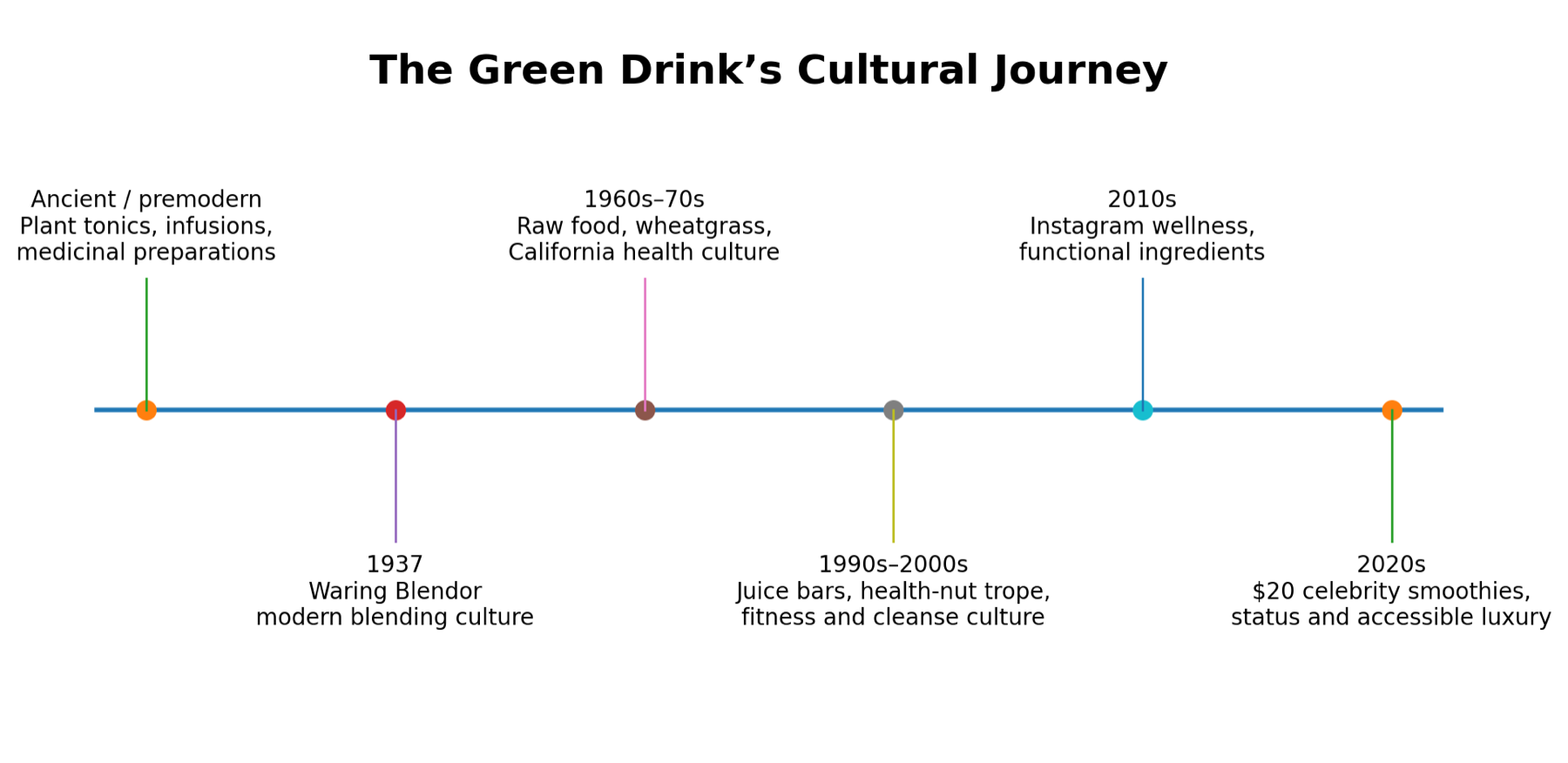
Figure 2. A simplified cultural timeline: ancient plant preparations met modern machinery, health culture, social media, and luxury branding.
The basic idea is ancient. Humans have soaked, crushed, boiled, fermented, and extracted plants into drinks for thousands of years. Herbal infusions, medicinal tonics, and plant preparations appear throughout human history.
But calling all of those “green drinks” would be cheating. The modern green drink depends on something distinctly modern: machinery.
Juicers make it practical to extract large quantities of vegetable juice. Blenders let us pulverize entire plants into something drinkable. Industrial drying lets us transform plants into powders that can sit on a shelf for months.
The green drink as we know it is therefore not simply an ancient health tradition. It is an ancient idea meeting a twentieth-century appliance.
Enter the blender
In 1937, bandleader Fred Waring introduced what became the Waring Blendor.
Think about what that machine did culturally. Before powerful household blending, eating a pile of spinach meant… eating a pile of spinach. Now the same plants could become breakfast.
That sounds trivial. It wasn’t.
The blender created an entirely new format for food. Frozen fruit. Milk. Yogurt. Vegetables. Ice. Supplements. Powders. Seeds. All of them could disappear into the spinning blades and emerge as one uniform drink.
By the mid-twentieth century, the technological foundation of modern smoothie culture had arrived.
Then the health people got hold of it
This is where things become wonderfully Californian.
Alternative-health movements had already been experimenting with raw foods, vegetarianism, sprouts, and vegetable juices.
One of the most influential figures in twentieth-century wheatgrass culture was Ann Wigmore. Wigmore promoted wheatgrass juice heavily through the raw-food and alternative-health world, particularly from the mid-twentieth century onward. Whatever we think of the more extravagant health claims surrounding wheatgrass, its cultural importance is difficult to miss.
Imagine the visual. A little tray of grass. A special machine. Dark green liquid dripping into a tiny glass. Drink it.
That is practically the prototype of the modern wellness shot.
The green colour itself started becoming evidence. It looked medicinal. It looked natural. It looked concentrated. It looked like it ought to be doing something important.
California takes over
If you’re looking for the natural habitat of the modern green drink, Southern California is difficult to beat.
Sunshine. Year-round produce. Body culture. Hollywood. Vegetarianism. Surf culture. Gyms. Alternative medicine. Beauty culture. And an unusually powerful ability to transform lifestyle experiments into products sold to the rest of the world.
In 1975, David and Jennifer Otto opened Beverly Hills Juice Club. David Otto had become vegetarian and started experimenting with a Champion Juicer. Friends encouraged him to sell his concoctions.
The location was almost comically perfect. The shop sat on Santa Monica Boulevard between the Beverly Hills Health Club for Men and the Beverly Hills Health Club for Women. If you wanted to design a laboratory for the commercialization of juice culture, you’d struggle to improve on that.
Green drink, meet Hollywood
And now something important happens. Food stops being merely food when filmmakers can use it as shorthand.
A cigarette can tell us something about a character. So can champagne. So can black coffee. And eventually, so can a green drink.
Hollywood discovered that a glass of green sludge could communicate a character’s personality before the script explained anything.
Sometimes the joke was: This person is an unbearable health nut.
In older film and television, an unpleasant-looking green health concoction often worked because the audience already understood the joke: green meant healthy, and healthy therefore probably meant revolting.
That version of the green drink matters. Green meant healthy. Healthy meant unpleasant. Therefore the comedy worked.
But watch what happens over the following decades. The joke changes.
The Hollywood green drink scene
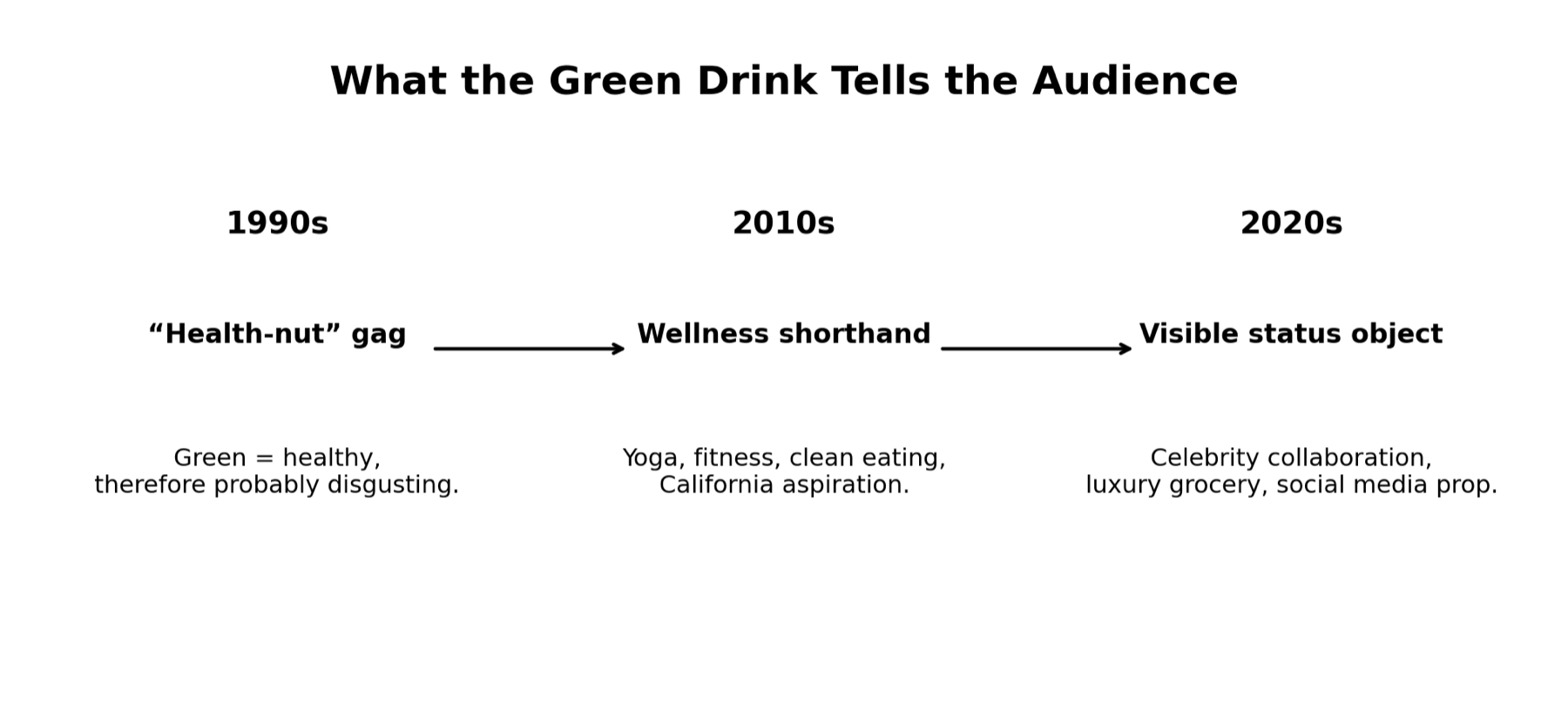
Figure 3. The green drink’s screen shorthand evolved from “health-nut punishment” to wellness signal to visible status object.
Imagine three establishing shots.
Scene one: 1992
Suburban kitchen. Mother has discovered health food. Child stares suspiciously at an ugly green concoction.
“What’s in it?”
“It doesn’t matter. It’s good for you.”
The child tastes it. Disgust.
Green drink = punishment disguised as health.
Scene two: 2010
Los Angeles apartment. Yoga mat against the wall. Someone in expensive workout clothes opens the refrigerator. Green juice. They grab it while running out the door.
Green drink = health-conscious Californian.
Scene three: 2026
Sunlight. Marble countertop. Pilates outfit. $700 handbag. Phone comes out before the drink is touched.
The smoothie is pink-green-beige, layered beautifully against the cup. The logo faces the camera. Photograph. Sip.
Green drink = lifestyle.
That’s an extraordinary cultural migration.
By the 2020s, film, television, and celebrity media no longer need to explain the green juice. The audience already knows the code. It belongs naturally beside fitness, beauty, expensive groceries, and aspirational urban life.
That’s how you know a cultural symbol has arrived.
Then came the cleanse
The next stage was more intense. If drinking vegetables is healthy, perhaps drinking only vegetables is healthier.
Enter the juice cleanse. Bottles numbered one through six. Day One. Day Two. Day Three. No chewing required.
The cleanse combined several very old human desires: purification; fasting; weight loss; self-discipline; renewal; and the seductive idea that we can erase our previous bad behaviour by suffering virtuously for several days.
The green juice became secular penance.
Had too much wine? Cleanse. Vacation? Cleanse. Christmas? Cleanse. Coachella next weekend? Definitely cleanse.
Celebrity culture amplified the phenomenon, and reality television documented it particularly well. By this point, the drink was no longer a weird alternative-health product. It had become a recognizable component of celebrity wellness.
Then Instagram changed the drink
This may be the decisive transformation.
A dark green glass of vegetable sludge isn’t particularly photogenic. So the wellness drink evolved. Creamy textures. Colour layers. Coconut cream. Glass bottles. Perfect labels. Beautiful produce. Special cups. Branded powders.
Smoothies stopped merely being consumed. They became content.
And no company illustrates the transformation better than Erewhon.
The strange story of Erewhon
Erewhon didn’t begin as a celebrity smoothie factory.
Michio and Aveline Kushi founded the original Erewhon in Boston in 1966 as part of the emerging macrobiotic and natural-food movement. A Los Angeles location followed in 1969.
Think about that. The brand’s roots are in 1960s counterculture. Whole grains. Natural food. Macrobiotics. Alternative living.
Fast-forward half a century and celebrities are photographed carrying $20 smoothies from the same name.
Erewhon moved from counterculture to luxury culture. That transition is practically the entire history of modern wellness compressed into one company.
The $20 smoothie
Then came the celebrity smoothie.
Hailey Bieber’s Strawberry Glaze Skin Smoothie launched in 2022 alongside her Rhode skincare brand. It exploded. Reports have put sales around 40,000 per month during its high-profile run.
Soon celebrity and brand collaborations became a rotating cultural event.
The drink didn’t merely promise nutrition anymore. It promised proximity. To Hollywood. To beauty. To wealth. To whatever mysterious existence involves leaving Pilates and wandering into Erewhon at 11:17 on a Tuesday morning.
Health became something you could carry
This is the clever part.
Luxury traditionally requires expensive objects. Watch. Car. Handbag. Hotel. Restaurant.
The green drink democratizes luxury just enough.
Most people cannot casually buy a $6,000 handbag. A $20 smoothie? That’s absurdly expensive for a smoothie. But it’s attainable. You can temporarily enter the world.
You’re not buying spinach. You’re buying twenty minutes inside the tribe.
And somehow the colour green won
There’s another strange element to all this.
Green once made the drink look disgusting. Now green authenticates it.
A brown health drink looks questionable. A fluorescent blue health drink looks artificial. A deep vegetable green? That looks healthy.
We have learned a visual language. Green means: plants; nature; freshness; cleanliness; health; discipline.
The colour itself has acquired nutritional branding power. Which is why marketers love it.
But underneath the fashion is a very good idea
After all the cleanses, celebrities, wellness gurus, wheatgrass shots, Instagram videos, and $20 smoothies, we shouldn’t lose sight of something simple.
Putting plants into a drink is useful. Not mystical. Useful.
The cultural machinery surrounding green drinks occasionally becomes ridiculous because humans are very good at taking a decent idea and constructing an entire identity around it.
But the underlying behavior survived all these cultural transformations for a reason. It is easy. Drinkable. Portable. Customizable. Repeatable. And it makes consuming plants easier.
Perhaps the green drink’s greatest cultural achievement is not that it became fashionable. It’s that fashion convinced millions of people to willingly drink spinach.
That’s honestly rather impressive.
Research & further reading
- Smithsonian National Museum of American History. Waring Blendor. The museum notes that the blender was introduced in 1937 as a bartender’s aid. https://www.si.edu/object/waring-blendor%3Anmah_324295
- Beverly Hills Juice. Company history and the founding of Beverly Hills Juice Club in 1975. https://www.beverlyhillsjuice.com/about/
- Vogue. Inside Erewhon: Hollywood’s Cult-Favorite Wellness Location. https://www.vogue.com/article/erewhon-hollywoods-cult-favorite-wellness-location
- Vanity Fair. How Erewhon Became Everyone’s Favorite Grocery Store Hot Spot. https://www.vanityfair.com/style/2020/10/how-erewhon-became-everyones-favorite-grocery-store-hot-spot
- GQ. This Was the Year That the $20 Erewhon Smoothie Went Mainstream. https://www.gq.com/story/erewhon-smoothie-hailey-bieber-phenomenon
- Vogue Business. Reporting on the business of Erewhon and celebrity smoothie collaborations. https://www.vogue.com/article/the-business-of-erewhon
Editorial note
These articles distinguish established evidence, observational associations, individual anecdotes, and cultural interpretation. They are written for general informational purposes and are not medical advice.

A curious person with an internet connection, a growing library, an unfortunate tolerance for very long research rabbit holes, and a desire to understand things properly.
The Green Drink
A series in 4 parts. See the whole series.
- Part 1The nerd review of the daily green drink
- Part 2The green drink’s cultural historyyou are here
- Part 3The green drink economy: how we built a billion-dollar business out of vegetables
- Part 4A puff piece for Thrive Ultimate, because I like it
Continue reading
Prolonged fasting: the people who pushed its limits
Forty days, 382 days, and the extraordinary things people have sought through fasting.
Why humans fast: religion, history, and the meaning of going without
Fasting has appeared in different traditions for different reasons, often without a single shared origin.
Fasting and meditation: how to pray and meditate while fasting
Practical methods for personal transformation, drawn from direct experience, Christian monks, Buddhist teachers, Taoist philosophers, and ancient Indian texts.