
The nerd review of the daily green drink
What the science supports, what anecdotes can tell us, and where concentration or plant-defense chemistry complicates the picture.
There is something wonderfully suspicious about a glass of green liquid.
It looks healthy. Not normal-food healthy. Aggressively healthy. The sort of healthy where someone hands you a glass containing spinach, kale, cucumber, ginger, berries, flaxseed, algae, and three things you’ve never heard of and tells you it will “detox your cells.” Which raises an obvious question:
What actually happens if you drink a green drink every day?
Not for three days. Not as a cleanse. Every day. For years.
There are enough extraordinary claims surrounding green drinks that it’s worth doing the nerdy thing and separating several different questions.
- Do leafy greens actually improve health?
- Does putting them into a drink change anything?
- Is juice different from a smoothie?
- Do greens powders work?
- What do people who actually develop the habit say happens?
And perhaps most importantly:
Is there a simple green drink pattern worth adopting for life?
Let’s investigate.
First: what is a green drink?
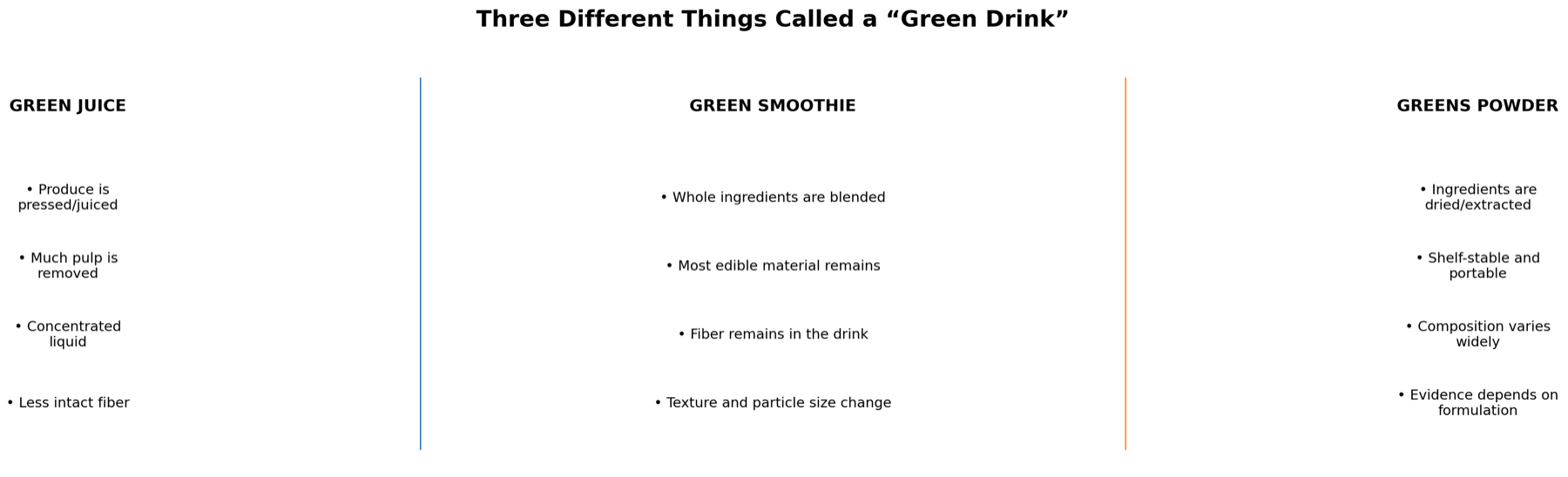
Figure 1. Juice, smoothie, and greens powder may all be called a “green drink,” but they are not nutritionally equivalent.
“Green drink” describes several things that look similar in a glass but are nutritionally quite different.
Green juice
Spinach, kale, celery, cucumber, parsley, apple, and similar foods go through a juicer. You drink the extracted liquid. Much of the fibrous material goes into the garbage or compost.
Green smoothie
The plants go into a blender. You consume essentially the entire plant. The blender mechanically breaks everything into tiny pieces, but the fiber hasn’t magically vanished.
Green drink powder
Plants, algae, grasses, extracts, vitamins, minerals, or other ingredients are dried and powdered. You mix the powder with water.
This is by far the most convenient version. It is also the version where consumers need to pay the most attention to what they’re actually buying.
A scoop containing meaningful quantities of recognizable foods is one thing. A proprietary mixture of 73 ingredients squeezed into a tiny serving is another. We’ll return to that.
The case for eating green things
Before studying green drinks, we need to establish something more fundamental. Are green vegetables actually good for us? The answer is considerably stronger than the evidence for most individual wellness products.
Leafy vegetables contain varying combinations of folate, vitamin K, vitamin C, carotenoids such as lutein and beta-carotene, potassium, magnesium, dietary nitrate, fiber, and numerous phytochemicals.
A 2026 systematic review and meta-analysis found that higher green-leafy-vegetable consumption was associated with an approximately 11% lower risk of cardiovascular disease and 21% lower cardiovascular mortality in observational studies.
That doesn’t prove the vegetables caused the difference. People who eat vegetables differ from people who don’t in plenty of other ways. And importantly, the randomized trials included in the same review did not find significant improvements in vascular function or blood pressure.
That’s exactly the sort of distinction worth making. Green vegetables look very good in long-term population research. They are not magic medicine.
Another interesting observational study followed 960 older adults for an average of 4.7 years. Higher leafy-green consumption was associated with slower cognitive decline. The researchers estimated the difference between the highest and lowest consumption groups as equivalent to roughly 11 years of age.
Again: Association, not proof of causation.
But we’re beginning to see why “eat your vegetables” has survived considerably longer than most nutritional fashions.
But why drink them?
This is where I think the real benefit of the green drink becomes apparent.
Imagine I tell you:
Make sure you consistently eat leafy vegetables, berries, seeds, and other nutritious plants throughout the week.
Okay. Reasonable advice.
Now imagine I tell you:
Every morning, drink the green thing.
That’s a system.
There is a blender on the counter. There is a bag of frozen greens. There are berries in the freezer. There is a scoop beside the container. You make it. You drink it. Done.
The enormous advantage of the green drink may therefore be less biochemical than behavioral. It turns a nutritional intention into a ritual.
Someone who occasionally eats spinach might eat spinach 70 times this year. Someone whose morning routine contains spinach might eat it 365 times. That difference compounds.
Does blending destroy the fiber?
This is one of those claims that gets repeated so frequently that it starts sounding obviously true.
Blending certainly changes the physical structure of food. But blending is not juicing.
If you put a cup of berries into a blender and drink everything in the blender, you haven’t somehow teleported the fiber out of existence. The structure and particle size have changed. The fiber remains.
There is even some intriguing experimental evidence challenging the assumption that blended fruit necessarily produces a worse glucose response. In a small experiment involving apple and blackberries, the blended fruit produced a lower glucose maximum and glucose exposure than the same fruits eaten whole.
That doesn’t mean blending every fruit always improves blood sugar. It does mean:
“Blender = destroyed fiber = sugar bomb”
is far too simplistic.
The ingredients and proportions matter enormously. A drink made mostly from spinach, berries, seeds, and unsweetened liquid is not metabolically equivalent to four bananas, mango, dates, honey, and apple juice simply because both emerged from a blender.
Green smoothie versus green juice
Here’s where I would generally favour the smoothie.
With a smoothie, we keep the edible plant material. With traditional juicing, much of the pulp and fiber is separated out.
Juice can still provide vitamins, minerals, and plant compounds. It can also be useful when someone specifically wants a concentrated drink without much bulk.
But for an everyday green drink? Why throw the fiber away?
Fiber contributes to bowel function, satiety, and the food supply available to parts of the gut microbiome.
If we’re designing a boring daily health habit rather than performing a temporary juice cleanse, keeping the whole plant makes considerably more sense.
What about energy?
This is where the science gets fuzzier and the stories get interesting.
People who regularly drink green smoothies commonly report things such as:
- more energy;
- more regular bowel movements;
- less snacking;
- improved digestion;
- better skin;
- fewer cravings;
- generally “feeling better.”
In online discussions, people often describe the same practical benefit: a smoothie lets them consume leafy greens, celery, parsley, berries, or seeds they otherwise wouldn’t eat consistently. Some report changes in digestion, energy, or skin; others report essentially no noticeable difference.
That’s useful information, but it belongs in the category of personal experience, not proof.
The most dramatic anecdotes are the easiest to remember and the least useful for establishing causality. Someone may add a green drink while simultaneously changing sleep, exercise, alcohol, smoking, total calorie intake, or the rest of their diet.
The interesting recurring theme is simpler: People start drinking green smoothies and simultaneously begin consuming dramatically more nutritious food.
Perhaps we shouldn’t be terribly surprised when some of them feel better.
Greens powder: the convenient cousin
Now things get interesting for me.
Because a blender is convenient. But a scoop is really convenient.
Put powder in glass. Add water. Stir. Drink. Thirty seconds.
That makes green powders potentially fascinating as a behavioral tool. Unfortunately, their marketing has raced considerably ahead of their clinical evidence.
One randomized, double-blind, placebo-controlled trial enrolled 105 women and compared the product Greens+ with a placebo for 12 weeks. Researchers specifically investigated claims involving vitality, energy, well-being, and illnesses.
The greens group reported significantly better scores on one secondary energy measure and marginally better vitality, but many outcomes weren’t significantly different. The researchers concluded that the results were positive but not conclusive.
That study was published in 2004. Twenty-two years later, you’d hope we’d have an enormous body of rigorous trials proving the extraordinary claims plastered across the modern greens industry.
We don’t.
That doesn’t make powdered vegetables useless. It means we shouldn’t confuse “These ingredients contain useful nutrients” with “This particular tub has been clinically demonstrated to produce everything written on the label.”
Those are completely different claims.
There is such a thing as too green
Here’s an excellent example of how health culture gets itself into trouble.
If spinach is healthy, surely enormous quantities of spinach must be extremely healthy.
No.
Spinach is high in oxalate. There are published cases of susceptible people developing serious oxalate-related kidney injury while consuming extreme quantities of oxalate-rich green juices or smoothie cleanses.
One particularly serious published case involved a 65-year-old woman with predisposing factors including previous gastric bypass and recent prolonged antibiotic treatment. She developed acute oxalate nephropathy after an oxalate-heavy green smoothie cleanse and progressed to end-stage kidney disease.
This is not an argument against spinach. It is an argument against turning healthy foods into pharmacological megadoses.
More is not infinitely better.
Rotate the plants. Use sensible amounts. Don’t design a daily drink around enormous quantities of one high-oxalate ingredient if you have kidney-stone or kidney-disease risk factors.
And vitamin K matters
Leafy greens are also famously rich in vitamin K. That’s normally a feature. It becomes important for people taking warfarin.
The solution isn’t necessarily “never eat greens.” Alberta Health Services advises people taking warfarin to keep their vitamin-K consumption relatively consistent rather than suddenly eating much more or much less.
If your normal diet contains almost no kale and tomorrow you begin drinking a giant kale concoction every morning, that’s exactly the kind of dietary change worth discussing with your healthcare provider.
Plants don’t actually want to be eaten
There is another side of vegetable nutrition that gets remarkably little attention in wellness marketing.
Plants aren’t passive packets of vitamins waiting for humans to eat them. They evolved under constant pressure from insects, fungi, bacteria, grazing animals, and other organisms trying to consume them. Because they cannot run away, plants developed an enormous chemical arsenal.
These compounds include alkaloids, lectins, protease inhibitors, oxalates, tannins, cyanogenic glycosides, glucosinolates, and many others.
Calling all of these compounds “toxins” isn’t particularly useful. Their effects depend on the compound, dose, preparation, species consuming them, and the physiology of the individual.
But pretending vegetables contain nothing except beneficial nutrients isn’t useful either. They are complicated biological organisms with their own defense chemistry.
Brussels sprouts are a wonderful example
Brussels sprouts belong to the Brassica family alongside broccoli, cabbage, kale, and cauliflower. These plants contain glucosinolates.
When plant tissue is damaged - by an insect chewing it, a knife chopping it, or a blender pulverizing it - the plant enzyme myrosinase interacts with glucosinolates and produces biologically active breakdown products including isothiocyanates and other compounds.
From the plant’s perspective, this is chemical defense. From our perspective, things become wonderfully complicated.
Some glucosinolate breakdown products have attracted enormous research interest precisely because they may have anticarcinogenic effects. Sulforaphane, produced from glucoraphanin in cruciferous vegetables, is one of the best-known examples.
At the same time, particular glucosinolate breakdown products can produce adverse effects under certain experimental conditions or at unusually high exposures. Some can interfere with thyroid iodine metabolism, especially when iodine intake is inadequate, while other plant compounds can produce cellular toxicity depending on dose and context.
So the intellectually interesting conclusion isn’t: “Brussels sprouts contain carcinogens, therefore Brussels sprouts cause cancer.”
Nor is it: “Brussels sprouts are natural superfoods, therefore more Brussels sprouts must always be better.”
It’s:
Plants contain biologically active chemicals, and biology is considerably more complicated than dividing food into toxins and superfoods.
This is actually a recurring theme in toxicology. The dose matters. The preparation matters. The individual matters.
And sometimes a biological stressor that is harmful at sufficiently high exposure may trigger adaptive responses at lower exposures - a phenomenon often discussed under hormesis.
That makes the green drink more interesting, not less. We’re deliberately taking dozens of plant chemicals, smashing their cellular structures apart, and drinking the resulting mixture. That’s worth understanding.
The green drink concentration problem
This also exposes a potential problem unique to health foods.
Ordinary eating imposes natural limits. Eating several cups of raw spinach takes effort. Drinking several cups of pulverized spinach doesn’t.
Juicing concentrates things further because enormous quantities of produce can disappear into one glass. Powders can concentrate them further still.
Suddenly a compound humans historically consumed as one component of a varied diet can appear in much larger and more repetitive quantities.
The same principle applies to oxalates. It applies to some goitrogenic compounds. It applies to micronutrients. It applies to extracts. And it applies to supplements.
This doesn’t make green drinks dangerous by default. It argues against the assumption that:
If a little is healthy, enormous quantities must be healthier.
That’s probably one of the most important principles in this entire article.
Variety may be the sensible answer
This gives us another reason not to build a daily green drink around gigantic quantities of one vegetable.
Rotate things. Spinach today. Different leafy greens another day. Berries. Herbs. Cruciferous vegetables. Seeds. Different colours. Different plants.
A diverse diet spreads both the nutrients and the plant-defense compounds across a wider range of foods rather than repeatedly hammering the body with unusually large quantities of one.
So what would actually happen after a year?
Let’s be careful here.
I can’t find convincing evidence that one daily green drink will:
- “detox” your organs;
- transform your skin;
- melt body fat;
- supercharge your immune system;
- or unlock some previously dormant reservoir of human energy.
But I can make a much more defensible prediction.
If your daily green drink causes you to consistently consume a greater variety of vegetables, fiber, and useful micronutrients than you otherwise would - and doesn’t simply add hundreds of unnecessary calories or extreme quantities of particular plant compounds - then it is probably improving the nutritional quality of your diet.
For someone whose diet was poor beforehand, the difference could be substantial. For someone already eating a highly varied, nutrient-rich diet every day? The difference may be small.
That’s the wonderfully unsexy conclusion.
The worse your existing diet is, the more useful the habit probably becomes.
The daily green drink pattern
And this brings me to the part I actually care about.
I don’t want a recipe requiring: half a cucumber; three stalks of celery; organic kale; frozen blueberries; half an avocado; fresh ginger; parsley; lemon; chia; flax; spirulina; wheatgrass; and seventeen minutes of washing, chopping, blending, and cleaning before I’ve had breakfast.
I’ll do that enthusiastically for four days. Then the blender becomes kitchen furniture.
The ideal daily green drink needs to satisfy a different optimization problem:
- Useful enough to matter.
- Cheap enough to use every day.
- Pleasant enough to drink every day.
- Simple enough that I actually do it every day.
That suggests a modular pattern: Greens + colourful plants + fiber + useful extras.
Rotate the plants instead of megadosing one fashionable ingredient. Avoid hiding tiny fairy-dust quantities of fifty ingredients behind an impressive-looking label. And make the serving meaningful.
Whether that comes from fresh vegetables, frozen ingredients, a simple powder, or some combination doesn’t particularly matter to the underlying habit. The point is to make the good behavior easy enough to repeat.
The green drink verdict
After digging through the science, I don’t think the green drink deserves either extreme reputation.
It isn’t magic swamp water. It isn’t useless wellness nonsense. It’s a delivery mechanism. And that’s actually more interesting.
Humans are remarkably bad at consistently doing things that are good for us. We know we should eat a varied diet. We know we should consume enough fiber. We know plants contain useful nutrients. We should also remember that plants contain potent biological compounds, and concentrated consumption isn’t automatically better consumption.
Knowledge isn’t usually the problem. Consistency and moderation are.
So perhaps the strongest case for the daily green drink isn’t: “This drink will change your life.”
It’s: “This makes one good decision almost impossible to forget.”
Drink the green thing. Get on with your day. Do it again tomorrow.
Research & further reading
- Kaewpradup T. et al. Dietary Green Leafy Vegetables and Cardiovascular Disease Risk: A Systematic Review and Meta-Analysis. Foods, 2026. PubMed: https://pubmed.ncbi.nlm.nih.gov/42587937/
- Morris M.C. et al. Nutrients and Bioactives in Green Leafy Vegetables and Cognitive Decline: Prospective Study. Neurology, 2018. PubMed: https://pubmed.ncbi.nlm.nih.gov/29263222/
- Boon H., Clitheroe J., Forte T. Effects of Greens+: A Randomized, Controlled Trial. Canadian Journal of Dietetic Practice and Research, 2004. PubMed: https://pubmed.ncbi.nlm.nih.gov/15217524/
- Makkapati S., D’Agati V.D., Balsam L. “Green Smoothie Cleanse” Causing Acute Oxalate Nephropathy. American Journal of Kidney Diseases, 2018. PubMed: https://pubmed.ncbi.nlm.nih.gov/29203127/
- Arora R. Glucosinolates and Their Hydrolytic Products - A Love Story of Environmental, Biological, and Chemical Conditions. Journal of AOAC International, 2024. PubMed: https://pubmed.ncbi.nlm.nih.gov/38913875/
- National Cancer Institute. Cruciferous Vegetables and Cancer Prevention. https://www.cancer.gov/about-cancer/causes-prevention/risk/diet/cruciferous-vegetables-fact-sheet
- Galanty A. et al. Do Brassica Vegetables Affect Thyroid Function? - A Comprehensive Systematic Review. International Journal of Molecular Sciences, 2024. PubMed: https://pubmed.ncbi.nlm.nih.gov/38612798/
- Alberta Health Services. Consistent Vitamin K Diet: Care Instructions. https://myhealth.alberta.ca/Health/aftercareinformation/pages/conditions.aspx?hwid=ud1301
Editorial note
These articles distinguish established evidence, observational associations, individual anecdotes, and cultural interpretation. They are written for general informational purposes and are not medical advice.

A curious person with an internet connection, a growing library, an unfortunate tolerance for very long research rabbit holes, and a desire to understand things properly.
The Green Drink
A series in 4 parts. See the whole series.
- Part 1The nerd review of the daily green drinkyou are here
- Part 2The green drink’s cultural history
- Part 3The green drink economy: how we built a billion-dollar business out of vegetables
- Part 4A puff piece for Thrive Ultimate, because I like it
Continue reading
What is fasting? What happens when you stop eating?
When food stops arriving, the human body doesn't simply run down like a phone with a dying battery.
The three-day fast: what happens during 72 hours without food?
Over seventy-two hours, a well-nourished person moves from normal post-meal metabolism into a state where stored fat, newly produced glucose, and ketones are doing much more of the work.
The seven-day fast: what happens during a week without food?
The body adapts brilliantly; adaptation still has a cost.